
Currently viewing the tag: "Flipcam"
Introduction
Faith Tucker used Flip Cameras to record interviews as part of a mock interview exercise. Here’s how she incorporated their use into her module and her observations after the event.
The exercise
Final year Geography students undertake a mock interview exercise during the autumn term as part of GEO3030 Geographers at Work. This module, which focuses on career planning and employability skills, incorporates an application exercise. Students are asked to complete a covering letter and application form for a graduate-level job. Following this, they are interviewed for the post. The interview is chaired by an experienced interviewer (someone from a local business or a senior member of University staff), with the panel made up of other members of the class. All students have the opportunity to be interviewed and take on the role of interviewer, enabling them to learn about both sides of the interview process.
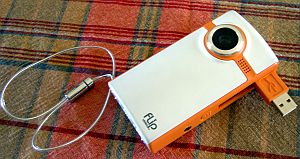
Flipcams are used to record each interview. The small size of the camera helps to make the videoing process unobtrusive. Each interviewee gets a copy of their video to help them review their performance. It also acts as an aide-mémoire: at the end of the academic year students complete a reflective report in which they review their learning from the entire module, and the video provides useful reminders about the interview experience. Feedback from recent graduates reveals that some have also used the video in preparation for interviews for real jobs.
Post-exercise observations
- the cameras were very easy to use;
- it was quick and easy to download the videos;
- the quality of the sound was a bit variable (you need to be quite close to the camera for quiet voices to be picked up effectively, which wasn’t always possible in this exercise).
Staff and students now have the technology available to record all or part of any presentation made as part of University activity.
Whilst the technology makes it easy to make the recordings, there are legal issues around these which control how they are used and promoted. The regulations for staff and students are different based on the fact that staff are employed by the institution. This guide (DOC, 40.5Kb) offers an insight into the differences in addition to a template form (DOC, 33Kb) which may be customised and adapted for staff and student’s own recording sessions.
Whilst the technology makes it easy to make the recordings, there are legal issues around these which control how they are used and promoted. The regulations for staff and students are different based on the fact that staff are employed by the institution. This guide (DOC, 40.5Kb) offers an insight into the differences in addition to a template form (DOC, 33Kb) which may be customised and adapted for staff and student’s own recording sessions.
Veronica presented on her experiences of using Flip Cams at The University of Northampton’s Technology Enhanced Learning Showcase 7/7/11. The event used Twitter hashtag #TELUoN.
It has now become very easy to capture video material using webcams and Veronica talked about her experiences of using these devices within a specific environment.
This case study looks at the use of handheld video cameras (Flip cameras), to allow students to record oral presentations for assessment.
This project was run as part of a third year Environmental Science module, by Dr Janet Jackson in the school of Science and Technology.
Using Flip cameras for oral presentations (case study, PDF 453KB)
Video clip of feedback from students
Mark Allenby is a Senior Lecturer in Social Work and is a strong advocate of Learning Technology. In this case study he looked at the uses of handheld video recorders in teaching students practical social work skills.
Kirsty Mason used the Flipcams during a simulated Child Protection conference, which had a big positive impact on the students and the tutors. Read more by following the link.]
More and more tutors in the School of Health are using Flipcams, and here’s another example of some interesting work which took place recently.
