
Currently viewing the tag: "History"

On Saturday 14th March 2026 the Learning Technology Blog will be 15 years old! With 646 posts published during that time (including this one), we’ve averaged 43 posts a year. Fittingly enough, our first post was written by Head of Learning Technology, Rob Howe, and Rob H still leads both the team and the blog scoreboard with a total of 258 posts on the LearnTech Blog. Yours truly makes it into second place with 114 posts, and our wonderful ex-colleague, Julie, is in third place with 76 posts.
The origin story of the Learning Technology Team and NILE goes back to 1st August 1997 when Rob H was appointed as the University’s first Learning Technology Adviser. Jump forward to 18th May 1999, and you have the beginnings of NILE, when, as he was by then, the Head of Academic IT Services, Rob H, wrote the discussion paper ‘Proposed Roadmap for NILE (Northampton Integrated Learning Environment)’. The Learning Technology Team as it is now formally began life on 1st September 2007 and since that time the team and its individual members have won various awards, and have benefitted from and enjoyed the brilliance and expertise of many fine people, twenty-six of whom have gone on to pastures new, but none have been forgotten. So, take a bow, Adel, Andy, Belinda, Cleo, Craig, David, Dom, Doreen, Gemma, Gez, Iain, Izzy, Jim & Jim, Julie, Kalina, Kerry, Kieran, Nicola, Omar, Rachel, Rachel, & Rachel, Rob, Simon, & Vicky. The team now comprises ten outstanding and highly-skilled colleagues who have made the University’s Learning Technology Team their home. So, take a bow too, Al, Anne, Kelly, Liane, Richard, Rob & Rob, Sean, Sharon, & Tim.
Over the years we’ve seen many tech fads, booms, threats and disruptors come and go. Some have been supposed panaceas (they weren’t), others have been on the verge of destroying the very fabric of education (they didn’t) – although often the same things were both. Whether the tech on offer was digital gold or, to quote the title of Tara Brabazon’s book, digital hemlock, it mostly depended on your perspective. Back in 1999 when Rob H wrote his discussion paper inaugurating NILE, it was the internet that was going to destroy learning, as Brabazon explained in her 2002 book, Digital Hemlock: Internet Education and the Poisoning of Teaching. In 2001 the perennially unhelpful term ‘Digital Natives‘ was coined, and you can read more about that term on the educational no-go zone that also started life in 2001, Wikipedia. Around 2007 there was a lot of interest in Second Life, and much money was spent (although not by us) on exploring whether it would be, as the Guardian headline put it, the ‘Campus of the future‘. Also in 2007 Martin Weller famously (well, it was famous in learning technology circles) announced the death of the VLE. (Although if you’re wondering what we’re still doing with a VLE you can check out his 2024 post, Things I was wrong about pt2: The Death of the VLE.) Starting in 2008, but really getting going by around 2012/13, MOOCs (Massive Open Online Courses) were causing ‘the ivory towers of academia [to be] shaken to their foundations‘. (By the way, anyone remember cMOOCs and xMOOCs?) Then in 2014 a paper by Freeman, et al., got lots of people thinking about active learning, and in 2015 we were all quite excited about the flipped classroom (well, I was). Folks who remember teaching at UON’s Park and Avenue campuses (cue nostalgic sighs) may remember using classroom response systems (a.k.a. clickers, and yes, they were a big faff to set up and use), and SmartBoards (yes, they were far too small, weren’t they). Also, around this time there were staff doing interesting things with iPods and iPads, as shown in our video Mobile Learning in Art & Design, and in the book Teaching with Tablets by UON innovative educator, Helen Caldwell, and James Bird. Others were doing interesting educational things on Twitter (back in the day, before it went bad), and for far too long everything had an ‘e’ in front of it, which made it seem cool and relevant, but now just makes it feel very dated and a bit sad. For more edtech nostalgia, check out VLE obituarist Martin Weller’s 25 Years of EdTech.
So what tech tools are coming along to disrupt, enchant, or destroy us these days? Well, we’ve all been enjoying the marvel that is Blackboard Ultra and revelling in its superiority to Blackboard Original (come on, you know you have). And the different realities, AR/VR/MR/XR (augmented reality, virtual reality, mixed reality, extended reality), have been well utilised in some specialist areas, but are yet to take off in a big way across HE, although English Lit grads will need no explanation as to why that is; after all, ‘human kind / Cannot bear very much reality’ (cue groans from T.S. Eliot fans, and nonplussed expressions from everyone else). Educational neuroscience appears to be a very exciting field with a great deal to offer, but today’s major topics of interest undoubtedly centre around artificial intelligence, and learning (or learner) analytics – and perhaps both together at some point, as it figures that there will be an AI-powered learning analytics system on offer soon. On the subject of AI in education, UON innovative educators David Meechan and Jane Mills have been making some fascinating inroads. David has kindly written a book called Generative AI for Students, which will help students to use AI sensibly in their studies without destroying themselves or humanity in the process. And Jane is leading the way on AI in art and design, and particularly in fashion, as you can see in her excellent talk Exploring the Fusion of Fashion and Artificial Intelligence. But to correct for bias it should be pointed out that not everyone is in favour of AI in education, quelle surprise, so cue Your Brain on ChatGPT and cut to Private Frazer saying ‘we’re doomed’. Fortunately, as well as the Learning Technology Team, the University now has its own Centre for Active Digital Education to help steer a course through the edtech mud? maze? swamp? wasteland? – take your pick – and help us figure out the useful tech from the useless fads.
So, to wrap up what was meant to be a short blog post, but, master of verbosity that I am, has already become far too long, Happy Birthday to the Learning Technology Blog, and a big thanks to all our readers out there (which I know sounds very grandiose, but during the 24/25 academic year alone we had a total of over 27,000 post views, so we must have one or two readers). And a special big thanks to anyone who actually got all the way to the end of this particular post: it was a bit TL;DR wasn’t it.
By Samantha Read, Lecturer in Marketing, FBL
Taking an active blended learning approach to the delivery of my Advertising module for the BA Marketing Management Top-Up programme has enabled me to enhance traditional ways of teaching the subject material for students to make constructive links between areas of learning and engage with theory in a fun and collective way.
Traditionally, I presented the students with a lecture-style presentation of the history of advertising, drawing on examples from the past and present to illustrate how advertising practices have changed over time. The subject material by its very nature is fascinating, from uncovering secrets behind Egyptian hieroglyphics to discussing implications of the printing press and debating the impact of the digital environment on advertising. Yet, without the ability to transport students back in time, it felt as if they were not fully able to appreciate the momentous changes that have taken place within advertising over the years.
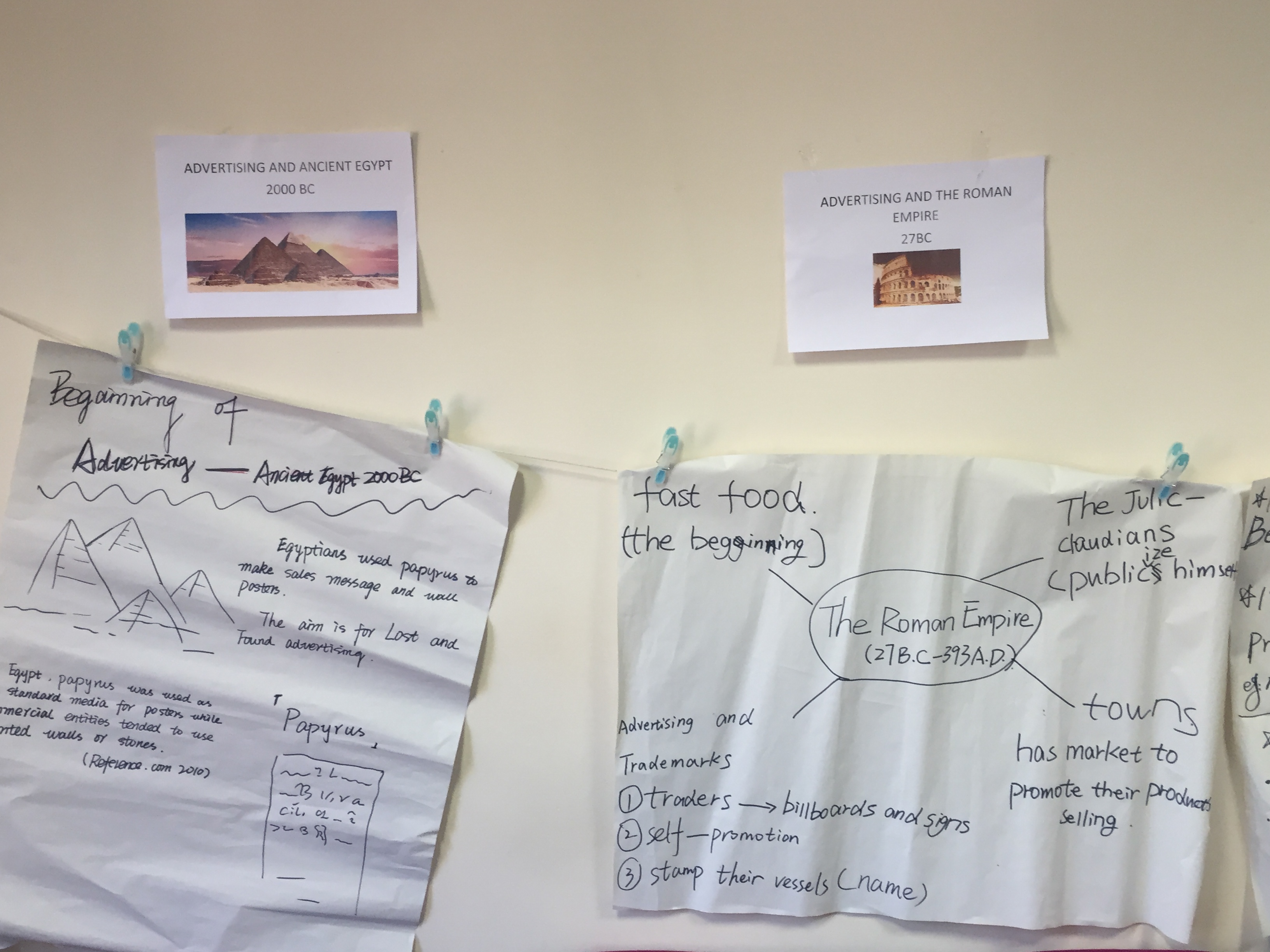
Example posters on the History of Advertising
To support the students in learning about the history of advertising this academic year, taking an active blended learning approach, I used a jigsaw classroom technique to facilitate a whole class timeline activity. Before the session, all students were asked to bring in their own device. Following an initial introduction in to the importance of reflecting on the development of advertising over time, I divided the class into seven groups of three or four students. Each group was then given just one piece of the timeline and had 30 minutes to research the implications of that section of history on advertising practice. This included ‘Advertising and Ancient Egypt’, ‘Advertising and the Roman Empire’, ‘The Printing Press was invented’, ‘The development of Billboards’, ‘Radio was invented’, ‘Television was invented’ and ‘The internet was invented’. Students were then given some suggestions of reliable sources where they could go online to research their given time frame and the importance of using these sources and referencing them was stressed.
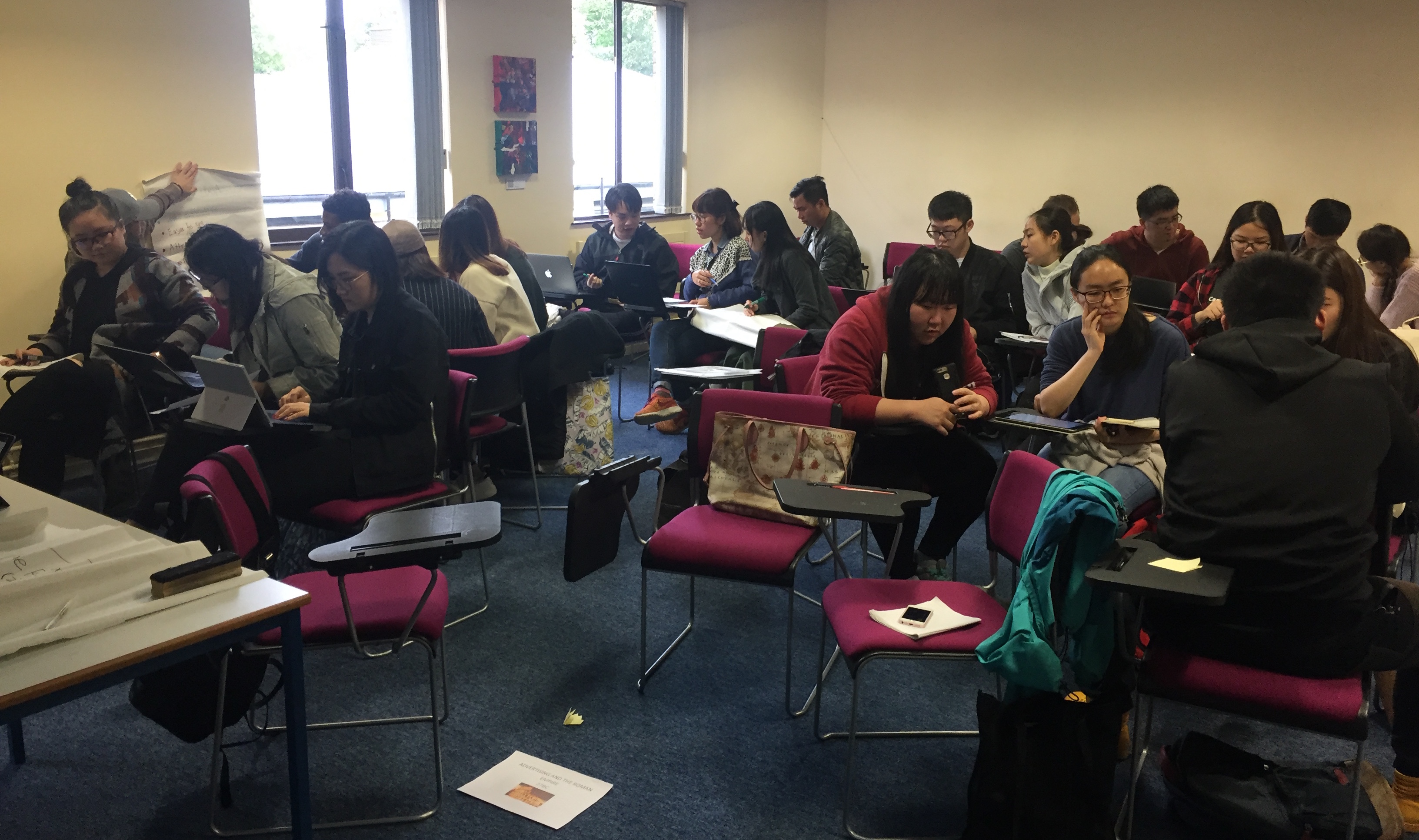
History of Advertising in the classroom
Whilst the students worked together in their groups to research and construct a one-page A3 poster on flipchart paper outlining their key findings, I circulated the room to check understanding of the research process and the content. This was particularly important as the majority of the students in the class are international students and unfamiliar with UK advertising practices or some terms that they were coming across. I was also able to check the students’ enjoyment of the task and to ensure that everyone in the group was happy to get involved. In contrast to a large lecture style format, the ABL workshop centred on each individual and their specific progression throughout the workshop session.
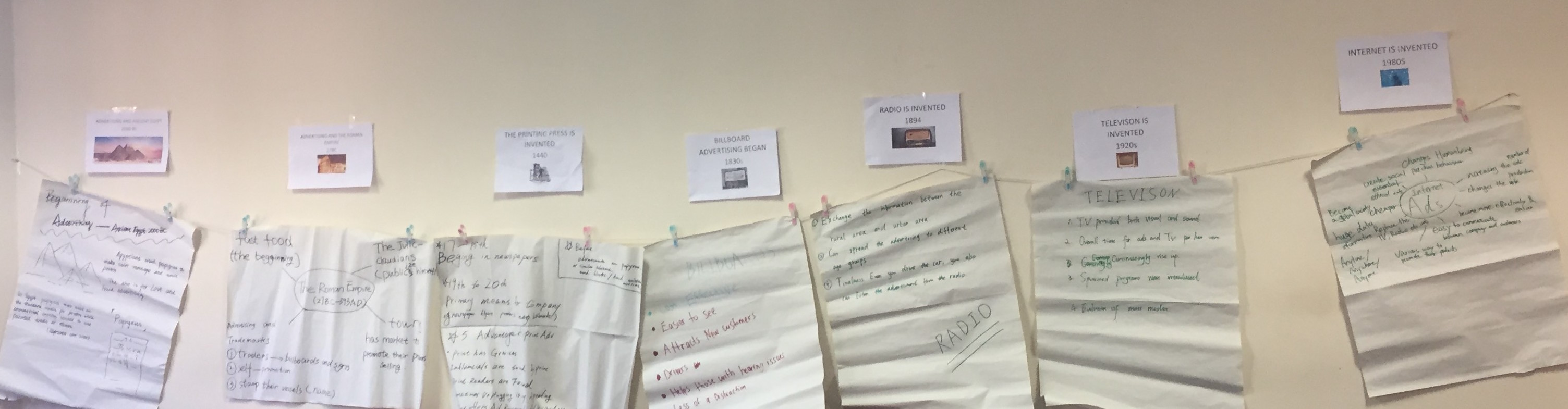
History of Advertising Timeline
Upon completion of their A3 poster, each group was instructed to peg their work to the washing line timeline I had attached to the back wall by fitting their time frame within the correct historical period. This ‘active’ jigsaw part of the session not only served a purpose to physically place each time period within its context, but also kept the students engaged in a whole class activity; the success of the timeline ultimately rested with all groups contributing. Once all of the assigned time slots were attached to the washing line, each group selected a member of their group to come to the back of the class to explain their key research findings in relation to the significance of their given time period to the development of advertising throughout history. Having a physical timeline to work with helped sustain the students’ interest in the task and the students themselves were able to make links between each other’s posters, adding to their own and others’ knowledge and understanding.
To ‘blend’ this session to the online environment and subsequently in to the next week’s workshop focusing on the nature of advertising in society, students were asked to complete a survey on NILE which compared print and TV toothpaste advertisements over time. They were also asked to reflect in their online journal on any similarities and differences between the UK based ads included in the survey and those from their home countries. Tutor support and feedback was given on this exercise to ensure that knowledge was accurately embedded and contextualised. Students were also asked to collect three examples of advertisements that they came across over the course of the week as a starting point for a semiotic exercise at the beginning of the next workshop.
Overall, I found the jigsaw classroom technique worked extremely well as part of an ABL approach to teaching the history of advertising. Rather than passively taking in knowledge as I had previously witnessed when delivering this session in the past, there was a real buzz in the classroom. The students were all invested in working together to complete their part of the timeline and were even taking photographs of their completed work. One important aspect of facilitating learning for me is providing opportunities for creativity both in the classroom and online, and taking an ABL approach certainly allows for that.
This post is the first in a new series of ABL Practitioner Stories, published in the countdown to Waterside. If you’d like us to feature your work, get in touch: LD@northampton.ac.uk
