Closed Captions and Kaltura

The big Kaltura news for September is that users will now begin to have automatic machine-generated (ASR) Closed Captions created for any new video uploaded to their MediaSpace account. This is a significant step forward in making our learning content accessible to all our students.

When the captions are created, the CC icon will appear at the bottom of the video player, and viewers just need to select the icon to read them. If the captions are not 100% accurate, the video owner can correct them using the Kaltura Caption Editor within MediaSpace. There is a handy FAQ which explains how to edit the captions.

The many thousands of videos created before September will also be getting Closed Captions during the autumn to bring us in line with new accessibility legislation. In the meantime, if any videos created pre-September need captions, the Learning Technology team can help process priority caption requests.

Finally, if a student is referred from ASSIST and needs course videos captioned and the machine captions aren’t available or accurate enough, the Learning Technology team can authorise a special request for professional human-created captions to be created.

It’s important our video content is accessible to all our students and the Closed Captions project is going to help achieve that. If you have any questions about Closed Captions at Northampton, then email the Learning Technology team at learntech@northampton.ac.uk

NILE Summer Upgrade

The upgrade during summer 2019 has brought with it some new features. Please find a summary and links to further information below. If you are interested in any of these features and would like more support to use them, please get in touch with your learning technologist

Create a voice recording as feedback

Similar to the voice recording in Turnitin Feedback Studio, instructors can now also use a voice recording feature when marking submissions in the Blackboard assignment type. Please note that if you wish to use a voice recording for feedback, the tool native to the assignment type should be used, i.e. Turnitin Feedback Studio for Turnitin submissions and Blackboard grade centre feedback for other assignments. More details can be found here: https://help.blackboard.com/node/25091

Record attendance in NILE

Please note that this new feature is not linked to any other University system. Instructors wishing to record attendance are able to do so in their NILE module and export a spreadsheet for records. https://help.blackboard.com/node/25071

Excellent Use of Rubrics

Abbie Deeming, Senior Lecturer in Education, has been commended by students and external examiners for her assessment guidance and feedback, and use of marking rubrics. These rubrics meet the University’s requirement to mark to learning outcomes, and make the criteria used in marking clear to students, which is one of the questions that students are asked on the National Student Survey.

cartoon character holding a red pencil drawing a big red tick, to denote marking

“By providing students with clear guidance and good quality, consistent feedback that is personalised and tailored to the individual and which includes links to helpful ‘feedforward’ resources, we are seeing an increase in students better reaching their potential. As a team, we are working to ensure that this excellent practice is represented throughout all modules in the Foundation Degree in Learning and Teaching (FDLT).”

Abbie Deeming

Feedback from Students

Regarding the use of rubrics on the FDLT programme, comments from students were very positive.

“I found the marking rubric very helpful to see how I met the criteria for each LO [Learning Outcome] and for what I need to be more careful with in the future.”

“The rubric is very clear and helpful. Being presented as a grid means it’s easy to read and can be used as a checklist when reading through assignments before submitting. The feedback is really detailed and helpful. I know now what I need to focus on to improve my next one!”

“I found the marking rubric very useful as it clearly outlines what needs to be covered within the assignment. I could also find the little fine details within the marking rubric too, even the formatting. The feedback I found very useful too. In fact I would like to email my appreciation. Overall the feedback was very good as it broke down everything that needs to be improved on, whilst also highlighting the excellent bits from the assignment. Although the feedback was “savage”, I understand it has to be to help us as writers improve. Thank you.”

“I thought that the feedback was very useful. I keep looking back at it then looking at my report to see what I can improve. It was very helpful and hopefully next time I improve. Many thanks.”

“The rubric gave me lots of confidence as I was able to easily see what my strengths were. Overall, I’m thrilled with the feedback. I’m under a lot of stress at the moment but I’m pleased I’ve still produced a good piece of work.”

Example

Below is a copy of the assessment guidance and the marking rubric, created for PDT1065: Pupil Engagement and Assessment. The purpose of the module is to engage students in studying the theory and practice of supporting learning, the assessment of learning and of learner needs, and principles of planning to advance learning. It also provides students with the opportunity to develop their own study skills. The assessment is a 3,250 word report, exploring both formative and summative assessment, reflecting on current practices within a setting and referring to relevant literature on the subject of assessment.

PDT1065 Assignment Brief and Rubric

Recommendations

  1. Firstly, determine what exactly are we looking for in this assignment, and how do we make this explicit.
  2. Break down the module learning outcomes against grading criteria to create a rubric which makes it clear what the assignment must look like to equal a pass, merit, or distinction. 
  3. Communicate this clearly and consistently to students – they will be more likely to achieve better grades.
  4. Make the assessment guidance and criteria used in marking clear to students in the assignment brief
  5. Advise students to look at the distinction column of the rubric, and to make this into a ‘to do’ list.
  6. In taught sessions, help students make the connection between the session content and the learning outcomes.
  7. Following each session, suggest readings for students to look at in more depth to help strengthen their assignment.
  8. Arrange a tutor and learning development-led session on the theme of ‘understanding your assignment’.
  9. Ensure consistency across the module team, including partnering with associate lecturers to talk through the learning outcomes, and to explain the ethos behind the use of a marking rubric, i.e., clear guidance and consistency.
  10. You will find that marking to LOs helps the marking tutor as well, as there is clear guidance on where the mark falls.
  11. Overall comments should be positive, detailed, and helpful. Aim to give between two and four action points (feedforward), depending on the student and grade. At the next assignment, ask students to note how they have responded to these points.
  12. On the assignment post date, send an announcement via NILE, offering individual tutorials if clarification is needed on action points.

Feedback from External Examiner

Extract from Summer 2018 Report on PDT1065
Section A2: Measuring achievement, rigour and fairness:

  • “Assessments are flexible and inclusive and allow for a range of different responses based on the students’ workplaces and experiences.”
  • “Assessments are tightly and clearly linked to the learning outcomes.”
  • “The quality and quantity of written feedback to the students is a major strength of this course. As I found last year, feedback is universally positive, detailed and helpful.”

“In talking to colleagues on the course, it is clear that they feel very strongly that this is an integral part of the process of teaching and supporting their students to the best of their ability.”

Further reading

  • Dylan William (2009) Assessment for Learning: Why, what and how? Institute of Education
  • John Hattie (2008) Visible Learning. Routledge
  • Shirley Clarke (2008) Active Learning through Formative Assessment. Hodder Education

NILE quality standards 2019-20

NILE is integrated into the Active Blended Learning (ABL) process at The University of Northampton and we need to ensure that it is being used effectively by staff in order to provide a quality student experience.

Building on the guidance which was initially produced in January 2012, the  framework has now been updated to cover the minimum standards which are expected on a NILE site. This was approved at University SEC in March, 2019 and is subsequently being used as the basis for the new NILE templates which have been developed for the 2019/20 academic year.

2018 Blackboard Learn (NILE) Upgrade

Blackboard Learn (NILE) is being upgraded on Saturday 18th August 2018 and will be unavailable from 22:30 BST until 10:30 on Sunday 19th.

The upgrade is necessary to maintain performance, stability, and security. This upgrade will also bring a new look to NILE, designed to work better on small screens and mobile devices. Some of the colours and layout will be slightly different and there will be standardised colours across all sites. If you have previously used fontawesome icons in your NILE sites, these will no longer be displayed after the upgrade, but the surrounding content will be preserved.

NILE 2018-19 sites now available

We are pleased to announce that your 1819 module and programme sites have been created and are now ready to receive your content, so you can self-enrol now.

This year (as last) we have again chosen to differentiate between courses taught at the University and those delivered by our academic partners, to reflect the different needs of all concerned and so LearnTech has developed and updated separate templates, making for a more tailored student (and staff) experience.

The template and NILE Standards have been updated for 2018-19 following recommendations approved at the University’s Student Experience Committee and Faculty SECs. Please refer to these for up-to-date guidance on what to include in which section of your NILE sites when preparing them for the coming academic year.

You will note that in-site guidance has again been streamlined to allow for any necessary dynamic updates throughout the academic year, incorporating links to existing support, thus avoiding duplication and avoiding potentially conflicting advice. We have again included the ‘Support for Tutors’ and ‘Support for Students’ resources lists, so please also refer to these for your own assistance and for that of your students.

The template is designed to build on last year’s updating of content: you should therefore all find yourselves in a strong position for this year’s plan to copy over only what is required for the coming years teaching.  N.B. If you are using Pearsons content, please do not copy over any site content without first contacting Learning Technology.

For those of you unfamiliar with the process of preparing your sites for the coming year, we have provided updated guidance on how to do this, as well as having Learning Technology team members on standby should you require extra support and assistance. Please email LearnTech Support in the first instance or contact your designated LearnTech.

NILE quality standards 2018-19

NILE is integrated into the Active Blended Learning (ABL) process at The University of Northampton and we need to ensure that it is being used effectively by staff in order to provide a quality student experience.

Building on the guidance which was initially produced in January 2012, the  framework has now been updated to cover the minimum standards which are expected on a NILE site. This was approved at University SEC on 28th February, 2018 and is subsequently being used as the basis for the new NILE templates which have been developed for the 2018/19 academic year.

Some students made unavailable on NILE sites – Monday 8th January, 2018

On Monday 8th January around 1pm there was a routine housekeeping check on NILE to ensure that it was in line with the student record system data. Unfortunately, this did not work correctly and as a result, some students were made unavailable on sites. The students were not removed from the sites but just lost the ability to view these on their NILE list. Any assessment work previously submitted by the student to the site was retained.


The Learntech team along with IT Services worked on the problem as soon it was identified and finally corrected the problem for all students at 8pm on the 8th January. A number of students were directly in touch with the Learntech team during the afternoon / evening and access was restored for them during the day. We are working with the supplier to ensure that there is no repeat of this problem.


Kathryn Kendon has agreed that for students impacted by this problem with assignments due in 8th January and 9th January, revised deadlines of 10th January (for those with deadlines of 8th January) and 11th January (for those with deadlines of 9th January) will apply. The list of modules which were impacted by the problem have been identified and module leaders were contacted on Tuesday 9th January by the Student Records teams. The extensions will only apply to students impacted by the problem on the affected modules.

Enhancements to NILE login

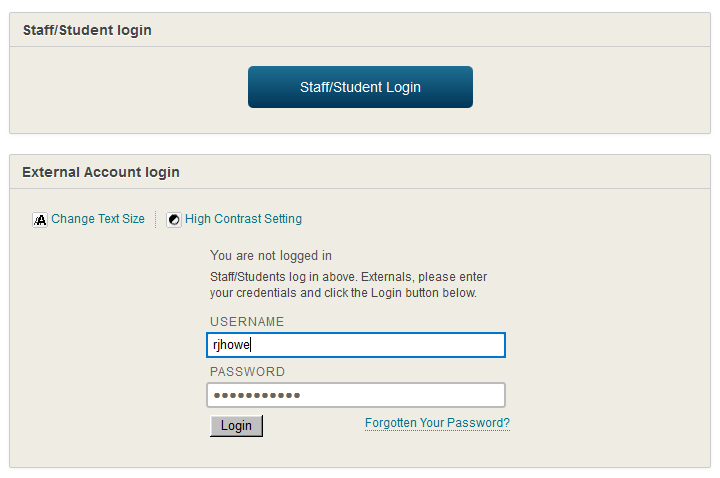
We have just enabled an improved way for staff and students to login to NILE. The screen below shows the new Single Sign On (SSO) button which you will now see on the NILE login screen. By clicking onto this button, your machine will try to log you in using details already held on your computer. If it fails then it will just ask you to type in your normal username and password.


The box below this is actually the same box that was previously on NILE and this will also work if your type in your details in the old way.  If the new button does not immediately work then you may just need to clear your browsers cookies using the details at the bottom of this message.


NILE SSO image


Clearing your browser cookies​​


If you receive an error when trying to log in, it may help to clear your browser cookies. When doing so, ensure you don’t select other items that you want to keep. For example, you may wish to keep saved passwords and your browsing history.


  • The keyboard shortcut for Firefox, Chrome and Internet Explorer is ctrl+shift+delete. For Safari it is ctrl+alt+e.
  • If you are unsure on how to clear cookies for your particular browser, please refer to the browser’s own website for help.

NILE 2017-18 UoN programme sites now available

In the wake of the creation of the new 1718 module sites, we are delighted to announce the unveiling of this year’s programme sites.

Following a recommendation to encourage a more uniform use of and engagement with these sites represented in the paper to SEC in February to help foster student programme identity, a task and finish group was subsequently formed to address what was required within the template. This resulted in the production of a more user-friendly left-hand menu and an updated version of NILE minimum standards to incorporate suggested content for each section. These were finally approved at SEC in May 2017.

A part of producing the updated template was involving colleagues across student facing services: this has allowed us to incorporate some core content for your programme sites in order to enhance the quality/clarity/consistency of information across all sites in all Faculties. We now require the programme leaders and their colleagues to take ownership of these sites and following the guidance, to add programme/ subject specific content for the benefit of your students.

As always, the Learning Technologists are on hand to help you if assistance is required.