
Patchwork Text Assessment

Patchwork TextIn 2003, Richard Winter wrote a piece for the Guardian in which he listed some problems than can occur when essays are the primary tool used to assess what, and how much, students have learned. Winter claimed that the essays students write often show evidence only of surface learning, rather than deep learning, and that the use of essays for assessment was partly to blame for this. Personally speaking, I really like the essay. I find it stimulating, challenging, and an opportunity to examine and learn in great detail and depth. However, regardless of how much one might like the essay, sometimes it could be useful to provide students with a friendly way in to academic writing, especially for first-year undergraduates or those returning to education after a break, and this is where patchwork text assessment comes in.

The basic idea is that rather than choosing one or two major points of assessment, the students submit multiple short pieces of writing on a regular basis (perhaps in the form of an academic blog or journal) which are then ‘stitched together’ with a final summary, evaluation or reflective commentary. The learning outcomes remain the same, the word count is not altered, and the final submission deadline stays as it is: the difference is that the writing is built up over a longer period of time, in which the students complete many short, directed writing tasks. The writing tasks could be similar or varied, and could be shared for peer-review or kept private. Tutors could review the writing tasks at one or two specific intervals in order to provide formative feedback, or could simply mark everything at the end of the process.

Dr. Craig Staff (Senior Lecturer in Fine Art) and Rob Farmer (Learning Designer) are currently conducting research into patchwork text assessment with students in the School of The Arts. The purpose of the research is to study the attitudes of students to this type of assessment, to look at the quality of the writing they produce, and to determine the staff workload implications when assessing the patchwork texts. The project is due to run over three academic years (2013/14, 2014/15, 2015/16), and will involve around 300 students from levels four to six. Interim findings from the students who undertook the patchwork assessments in 2013/14 clearly showed that it would be worthwhile continuing with the project.

Find out more …

Read Richard Winter’s 2003 Guardian article ‘Alternative to the Essay’

Visit the patchwork text pages of Richard Winter’s website

Watch the video of Dr. Craig Staff and Robert Farmer talking about Patchwork Text Assessment at the 2014 Library and Learning Services Research Conference

Visit the Digitally-enhanced Patchwork Text Assessment (DePTA) JISC project website

Follow Northampton … App Now Available!

Follow NorthamptonThursday the 23rd of October saw the appearance of the Follow Northampton app in the App Store. The app is a freely available interactive guide to Northampton, and it offers a fresh perspective on Northampton’s rich historical, architectural and cultural heritage. The app, and the associated website, were created and developed by staff and students at the University of Northampton and members of the wider Northampton community. The project leads were Dr. Drew Gray, Senior Lecturer in History, and Sabine Coady Schaebitz, Director of the Collaborative Centre for the Built Environment. Technical support and advice was provided by Rob Farmer from the Learning Technology Team, and the app was built by Chris Collinge from wedoApps. Content was developed by BA History students (Roseanne Belcher, Gabrielle Cairns, Jasdeep Dhillon and Steve Robinson), photographs were provided by a BA Photography student (Peter Holmes), and audio recordings were made of a number of (actual and honorary) Northamptonians, particularly Peter Aiers, Andy Clarke, Peter James Norman, Professor Nick Petford, and Dr. Toby Purser.

The app and website were made possible by the award of a Learning Enhancement & Innovation Grant from the University of Northampton. And the great news is that work on the app and the website is set to continue, as a second Learning Enhancement & Innovation Grant was recently given, and this will allow the project to cover more locations, and will allow the inclusion of extra features into the app. We are hoping to launch a second version of the app in March 2015, which will include full offline access to the locations, improved navigation, and additional locations. A third version is planned for July 2015 which will include design and layout updates, the addition of social media sharing options, and even more locations. In the longer term, we hope to add videos, iBeacons, and augmented reality, and to make an Android version of the app.

Get the iOS app: https://itunes.apple.com/gb/app/follow-northampton/id919466161?mt=8

Visit the website: http://www.follownorthampton.co.uk

NILE in Numbers

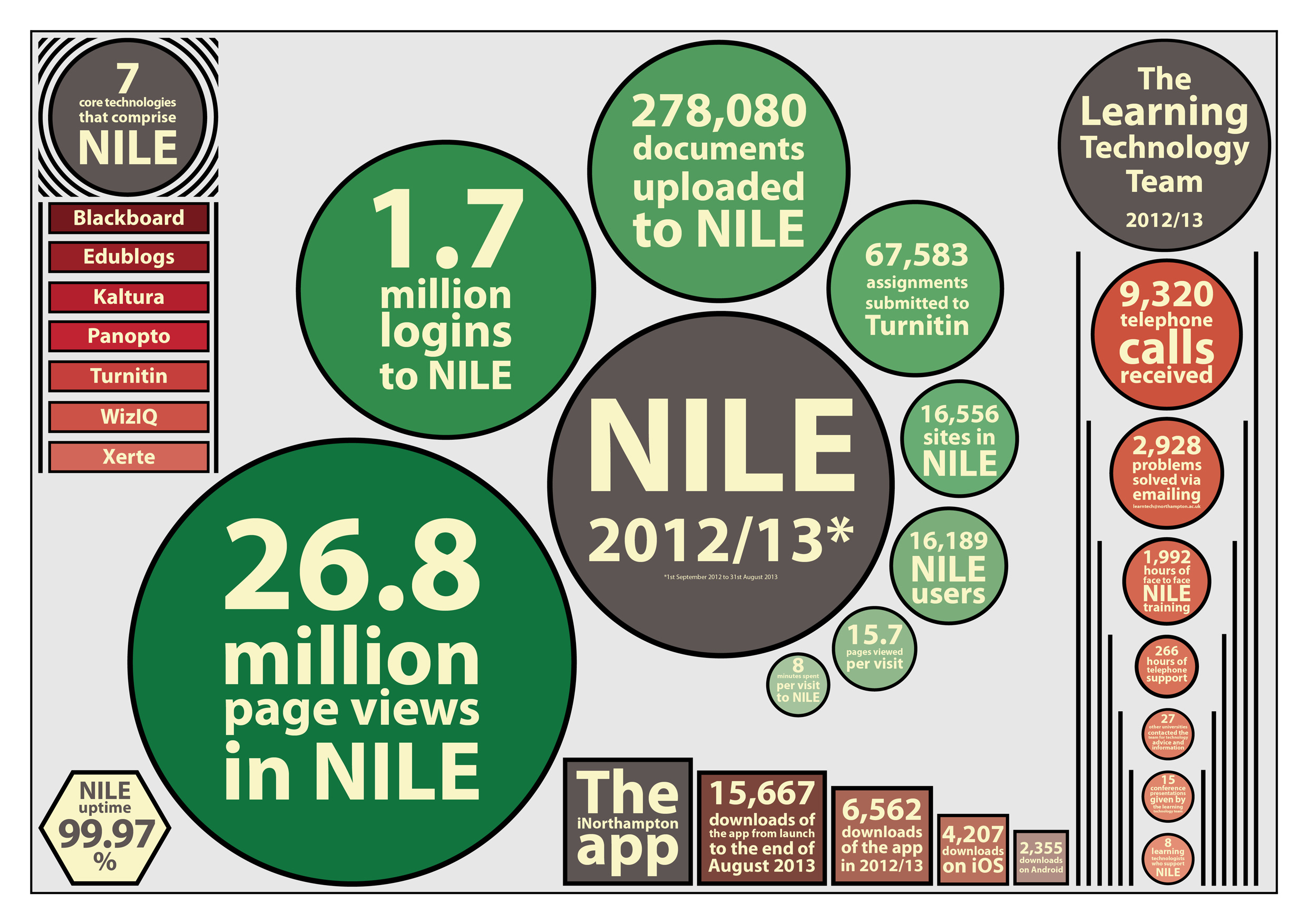
NILE in NumbersDid you know that last year 16,189 users logged into NILE 1.7 million times and viewed pages in NILE 26.8 million times?

Did you know that the iNorthampton app has been downloaded 15,667 times?

Did you know that NILE is available and working 99.97% of the time?

This, and other information about NILE and the Learning Technology Team is available on our infographic poster.

Click on the link below to download the PDF, or click on the image on the right to view the image full size.

NILE in Numbers (Download PDF)

Blogging and BA Fashion

First year fashion and surface design students have been given a fantastic opportunity to receive a substantial scholarship of £15,000. The Maggie Barwell Scholarship is awarded for ‘excellence’ and the full amount is given to support one fashion or surface design student spread over the duration of their degree studies exclusively at The University of Northampton.

A brief for applying for the scholarship was created. First year students applied for the award by presenting a selection of their first term’s work and creating a statement of intent with regard to their studies and their future aspirations. It was decided that the students should present their statement and examples of their work in a creative way through a blog using the MyPAD system. We have run the scholarship successfully in this way for the past 2 years.

Asking first year students to use a blog to present their work we feel is the way forward, and we supported any student to apply for the scholarship through a series of workshops where a member of the Employability team came and worked with the students to show them how to use the web tools effectively …

Watch the video: BA Fashion and Blogging
View blog examples: Example 1; Example 2; Example 3
Read more about the blogs: Using MyPAD Blogs